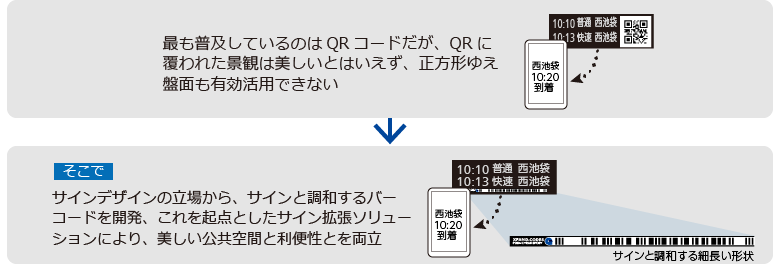
Meeting the Growing Demand for Information Augmentation
XPAND Code functions in a similar way to QR codes — it serves as the starting point for scanning and displaying information on a smartphone.
However, XPAND Code was developed solely for the purpose of augmenting wayfinding signs, road signs, and other posted signage. This is what sets it apart from other codes.
It All Started with Railway Signage
Around 2010, multilingual displays at railway stations began to take hold in earnest.
Ginza Transport Design, a company that had handled the display design for a great many railway signs including the Tokyo Metro destination boards, was also grappling with this challenge.
The trend towards multilingual displays was escalating — from two languages (Japanese and English) to four (adding Chinese and Korean), and potentially even six, incorporating Traditional Chinese for Taiwanese visitors and furigana readings on Japanese text.
Something had to be done about the situation where, in a rush to support more languages, the legibility of the signs themselves was deteriorating dramatically.
This concern drove the decision to keep the signs themselves simple, whilst supplementing multilingual and universal design requirements through a separate channel.
Having built and delivered official content for feature phones in the early 2000s, and with smartphones now beginning to proliferate, we chose to leverage them as our tool. Research began into a system that would allow users to scan a code affixed to a sign and access augmented information.
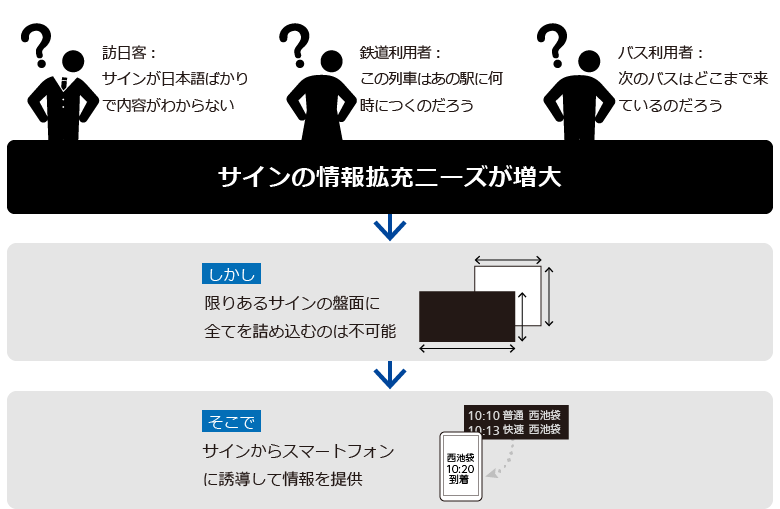
QR Codes Don't Play Well with Signage
The most promising candidate for the code was the QR code, which was already in widespread use at the time.
However, when a square QR code large enough to be scanned was incorporated into a sign whose width and viewing distance were measured in metres, it took up a disproportionately large area, effectively ruining the sign. It also left precious little room for the information the sign was actually meant to convey. Signage — as an element of public space — calls for a far more elegant solution.
So we made the deliberate decision to "reinvent the wheel". After extensive trial and error, exploring options beyond conventional codes, we arrived at the slit-shaped code that became XPAND Code.